

If there is a dataset you would like to see in Tilebox, you can request it in the Console open data page.
Accessing Open Data through Tilebox
Accessing open datasets in Tilebox is straightforward and as easy as accessing your own datasets. Tilebox has already ingested the required metadata for each available dataset, so you can query, preview, and download the data seamlessly. This setup enables you to leverage performance optimizations and simplifies your workflows. By using the datasets API, you can start prototyping your applications and workflows easily.Available datasets
Copernicus Data Space
The Copernicus Data Space is an open ecosystem that provides free instant access to data and services from the Copernicus Sentinel missions. Tilebox currently supports the following datasets from the Copernicus Data Space:Sentinel 1
Sentinel 1
The Sentinel-1 mission is the European Radar Observatory for the Copernicus
joint initiative of the European Commission (EC) and the European Space
Agency (ESA). The Sentinel-1 mission includes C-band imaging operating in
four exclusive imaging modes with different resolution (down to 5 m) and
coverage (up to 400 km). It provides dual polarization capability, short
revisit times and rapid product delivery.
Sentinel 2
Sentinel 2
Sentinel-2 is equipped with an optical instrument payload that samples 13
spectral bands: four bands at 10 m, six bands at 20 m and three bands at 60
m spatial resolution.
Sentinel 3
Sentinel 3
Sentinel-3 is equipped with multiple instruments whose data is available in Tilebox.
OLCI (Ocean and Land Color Instrument) is an optical instrument used to provide
data continuity for ENVISAT MERIS.SLSTR (Sea and Land Surface Temperature Radiometer) is a dual-view scanning
temperature radiometer, which flies in low Earth orbit (800 - 830 km
altitude).The SRAL (SAR Radar Altimeter) instrument comprises one nadir-looking antenna,
and a central electronic chain composed of a Digital Processing Unit (DPU)
and a Radio Frequency Unit (RFU).OLCI, in conjunction with the SLSTR instrument, provides the SYN products,
providing continuity with SPOT VEGETATION.Sentinel 5P
Sentinel 5P
The primary goal of
TROPOMI is to provide daily global observations of key
atmospheric constituents related to monitoring and forecasting air quality,
the ozone layer, and climate change.Sentinel 6
Sentinel 6
The Sentinel-6 mission represents a groundbreaking advancement in Earth observation,
providing invaluable insights for scientists, environmentalists, and stakeholders worldwide.
At the heart of this mission is the cutting-edge radar altimeter instrument, designed to
measure sea surface height and monitor key oceanographic parameters with unparalleled accuracy.
The Sentinel-6 satellite collects precise data by employing advanced radar technology,
allowing for a comprehensive understanding of sea level variations, ocean currents, and climate patterns.
United States Geological Survey (USGS)
The United States Geological Survey (USGS) provides a wide range of Earth observation data, including Landsat data, which are also available as open data through Tilebox.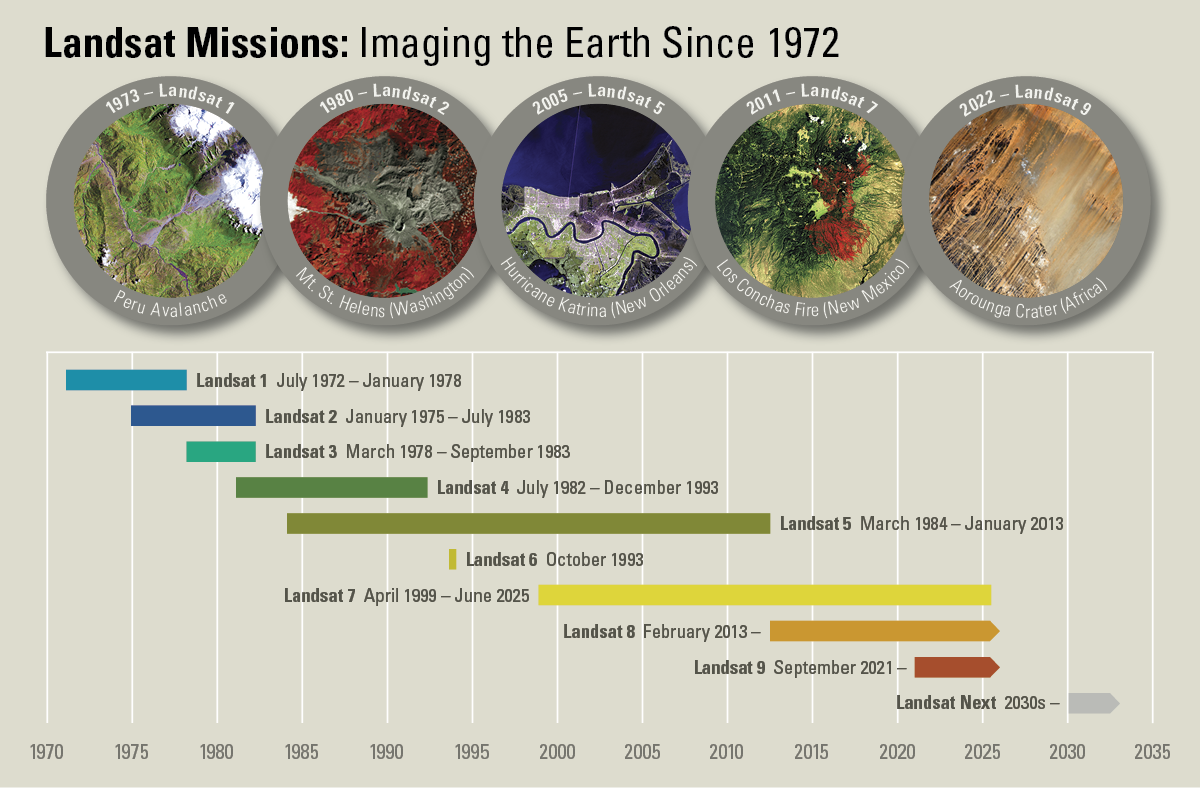
Landsat missions © USGS
Landsat 1-3
Landsat 1-3
Landsat-1/2/3 carry the Multispectral Scanner (MSS) instrument, which measures in the VIS and NIR portions of the spectrum. Its images have 79 m spatial resolution.
Landsat 4-5
Landsat 4-5
Landsat-4/5 carry both the Multispectral Scanner (MSS) which measures in the VIS, NIR and SWIR
portions of the spectrum in a 30m spatial resolution, and the Thematic Mapper (TM) instrument, which measures in the thermal-infrared band in a 120 m spatial resolution.
Landsat 7
Landsat 7
Landsat-7 carries the Enhanced Thematic Mapper Plus (ETM+) instrument, which measures in the VIS, NIR and SWIR and thermal-infrared
portions of the spectrum. Its images have 15-60 m spatial resolution.
Landsat 8-9
Landsat 8-9
Landsat-8/9 are part of the long-running Landsat programme led by USGS and NASA and
carry the Operational Land Imager (OLI) and the Thermal Infrared Sensor
(TIRS). The Operational Land Imager (OLI), on board measures in
the VIS, NIR and SWIR portions of the spectrum. Its images have 15 m
panchromatic and 30 m multi-spectral spatial resolutions along a 185 km wide
swath, covering wide areas of the Earth’s landscape while providing
high enough resolution to distinguish features like urban centres, farms,
forests and other land uses. The entire Earth falls within view once every
16 days due to Landsat-8/9’s near-polar orbit. The Thermal Infra-Red Sensor (TIRS)
instrument on board is a thermal imager operating in pushbroom
mode with two Infra-Red channels: 10.8 µm and 12 µm with 100 m spatial
resolution.
Alaska Satellite Facility (ASF)
The Alaska Satellite Facility (ASF) is a NASA-funded research center at the University of Alaska Fairbanks. ASF supports a wide variety of research and applications using synthetic aperture radar (SAR) and related remote sensing technologies. Tilebox currently supports the following datasets from the Alaska Satellite Facility:ERS SAR
ERS SAR
European Remote Sensing Satellite (ERS) Synthetic Aperture Radar (SAR) Granules
Umbra Space
Umbra satellites provide up to 16 cm resolution Synthetic Aperture Radar (SAR) imagery from space. The Umbra Open Data Program (ODP) features over twenty diverse time-series locations that are frequently updated, allowing users to explore SAR’s capabilities. Tilebox currently supports the following datasets from Umbra Space:Umbra SAR
Umbra SAR
Time-series SAR data provided as Opendata by Umbra Space.
Satellogic
Satellogic offers the EarthView dataset, which includes high-resolution satellite images captured over all continents. The dataset is available through Tilebox as a spatio-temporal dataset.Satellogic EarthView
Satellogic EarthView
High resolution satellite images provided as Opendata by Satellogic. The dataset provides Top-of-Atmosphere (TOA) reflectance values across four spectral bands (Red, Green, Blue, Near-Infrared) at a Ground Sample Distance (GSD) of 1 meter, accompanied by comprehensive metadata such as off-nadir angles, sun elevation, and other pertinent details. Users should note that due to an artifact in region delineation, a small number of regions present overlaps.
Wyvern
Wyvern offers a constellation of satellites providing high-resolution, hyperspectral imagery. They offer products from their Dragonette constellation as open data, which is also available through Tilebox as a spatio-temporal dataset.Wyvern Dragonette
Wyvern Dragonette
High resolution, hyperspectral imagery provided as Opendata by Wyvern.